



Why is access control in healthcare different?
Healthcare facilities have a duty of care for patients, staff, and visitors on site. This makes controlling access effectively critical to day-to-day operations.
- Reliable access control. Staff need dependable access 24/7, and security systems must keep people safe without getting in the way of staff delivering care to unwell or vulnerable people.
- Complex sites and permissions. Hospitals and clinics have rooms for all sorts of purposes. All of these areas are accessed by different people at different times, so detailed user groups and schedules are vital.
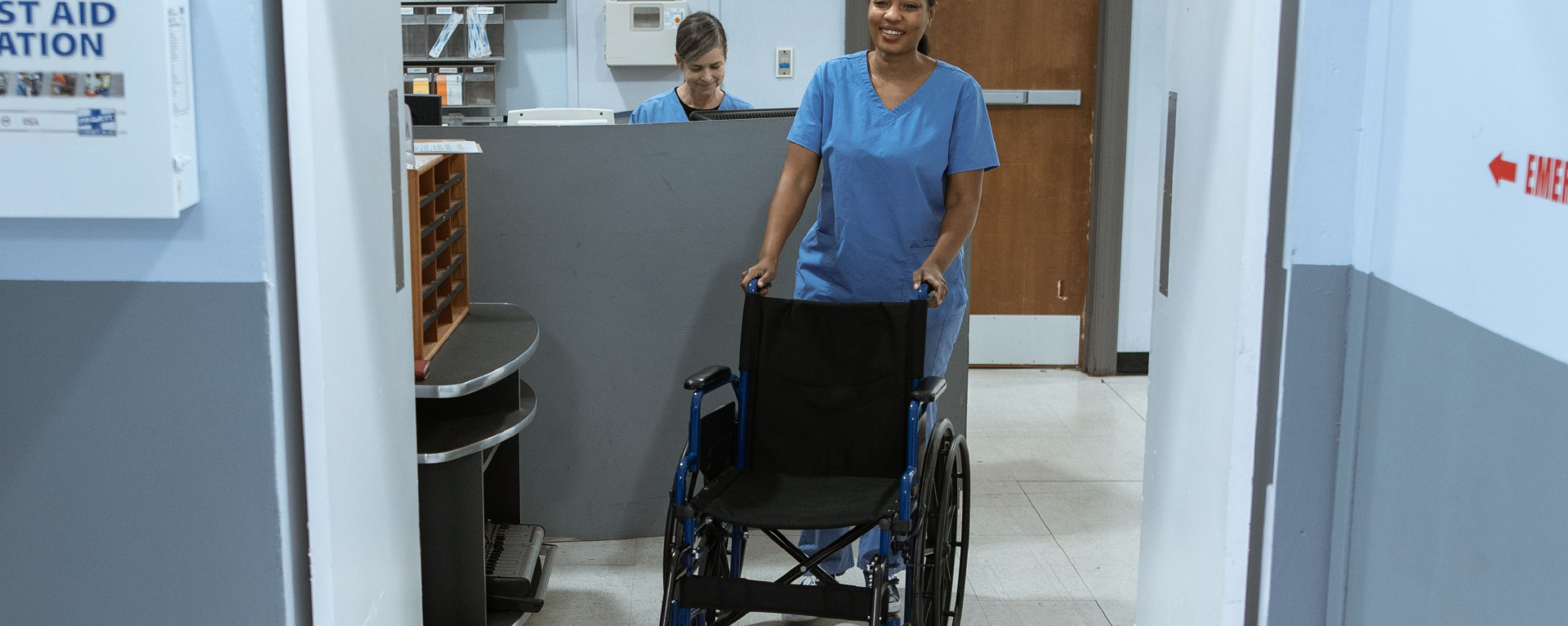
- Hygiene and accessibility. Prevention of disease transmission is paramount in a healthcare setting, so reducing shared touchpoints is a priority. In addition, wheelchair users and less mobile people need accessible entrances.
Our approach: safe, hygienic, easy to navigate
We’re here to help your healthcare sites operate safely and securely. That’s why our access control solutions for hospitals and clinics prioritise hygiene and accessibility.
 Centralised access management
Healthcare sites can be small or very large – and a centrally controlled access means complex user hierarchies and time zones are clearer and easier to manage from one place.

Touchless entrances
When hygiene is paramount to prevent infection, contact-free solutions like infrared buttons, radio transmitters, and automatic doors reduce the need to touch shared surfaces without slowing people down.

Integration
Siloed systems make running a hospital or health facility complicated and confusing. When all your systems work together, patients, staff, and visitors can move around smoothly and efficiently.

Access control for hospitals and large healthcare sites
Your challenge:
Large healthcare sites operate around the clock. They have thousands of staff, patients, visitors, and contractors entering, exiting, and moving between departments. Where and when different people can go depends on their role, shift, and department. Some areas, like pharmacies, records archives, and laboratories require tighter security.
Our solution:
Centralised access control with ATRIUM supports up to 500 doors and 10,000 users, with up to 1,000 permission levels and 250 time zones. This allows hospitals to tailor access rights to different roles across clinical, administrative, and support functions. For more sensitive areas, choose biometric readers like the ievo ultimate® to ensure that only authorised people can gain access.
Managing access in clinics and small healthcare settings
Your challenge:
Smaller sites still need to provide smooth access for staff and patients, as well as keeping medication storage areas and staff-only rooms secure. Day-to-day administration should be simple, entrances should be accessible, and the whole solution should not add an unnecessary operational burden.
Our solution:
ATRIUM access control works as well for small sites as for large ones. And in combination with touch-free buttons like the RTE-AIR and RTE-WIR, as well as automatic doors powered by DIGIWAY door operators, entrances can be accessible for less mobile patients. Staff can access the areas they need securely and easily, while patients and visitors benefit from smoother movement throughout the building.
Touchless access for improving hygiene
Reducing physical contact with shared surfaces is vital in healthcare environments. Solutions such as infrared exit devices activate with no touch needed – just a wave of the hand – while radio transmitters can send signals wirelessly to automatically open doors without the need to push or pull. Facial recognition devices further reduce the need for shared contact points.
🤚 Reduce contact with frequently used surfaces
🤚 Choose infrared or radio activated devices
🤚 Integrate access control and automatic doors for full control
Automatic doors for healthcare facilities
Automatic doors help patients, visitors, and staff move smoothly and easily through busy healthcare buildings. DIGIWAY door operators for swing doors improve accessibility for wheelchair users and people with limited mobility, while also enabling staff transporting patients and goods to get to their destination more easily.
🚪 Improve accessibility and movement around the building
🚪 Reduce the need to touch door handles or push plates
🚪 Support controlled opening with activation and safety sensors
Biometric control for restricted healthcare areas
Biometric readers mean users must be physically present at the door to gain access, with no risk of losing or sharing credentials. For restricted areas like pharmacies, laboratories, and storage areas, this solution improves security and monitoring. ievo fingerprint readers penetrate deeply into the surface of the skin and even work through some Latex gloves.
More reliable identity verification at sensitive entrances
Eliminates the risk of lost, stolen, or borrowed credentials
Creates clear access records linked to individual users
Recommended access solutions for healthcare facilities
-
A22K
High security encrypted 2-door controller
-
KPROX
Robust high security encrypted MIFARE® DESFire® EV2 reader
-
IEVO-U
ievo ultimate™ fingerprint reader
-
IFACE
ievo high speed facial recognition terminal, 12-24V
-
DWSR102U
DIGIWAY Spring Return door operator for single swing door with universal arm
-
EN16005-KIT-U-SR
EN16005 compliant kit - DIGIWAY SR, single door
-
SENSIR
Infrared hands-free transmitter
-
TX26-TTHS-B
1-channel radio touchless transmitter, black
 5 ways access control improves a healthcare facility
 How access control and automatic door systems work together
 The basics of biometric access control: What you need to know
 Types of door automation systems: a comprehensive guide